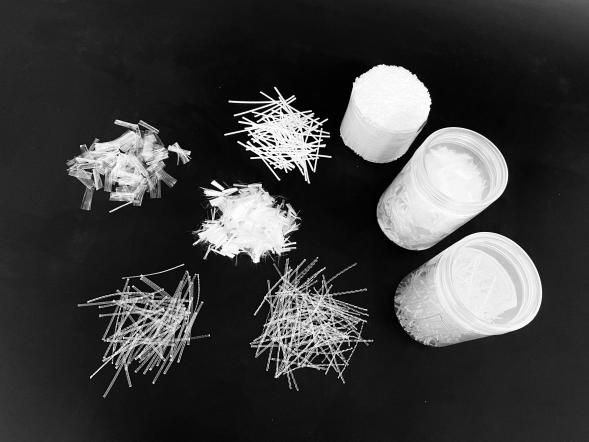
Beginning broad study about PP filament filament adaptations across the scope of masonry structures.
Polymers fiber optic provides notable reliable approach for increasing resilience and versatility throughout cement. Those small-scale pieces operate as typically blended inside the solution production, curbing breakage formation conjointly with enhancing endurance subject to compressions. Thus, the addition of synthetic reinforcements generates cement projects considerably sturdy plus long-lived
PP mesh in construction functions: The Elaborate Overview
Plastic fibers function as frequently employed across the aggregate sector as an productive practice for enhancing lifespan and effectiveness. These small inclusions, generally covering within 0.5 and 12 mm in scale, bring a range of features, consisting of curbed cracking and bending alteration. Unlike conventional steel armoring, polypropylene fibers are low-weight, degradation-resistant, and are capable of be conveniently dispersed into the cementitious.
- Decreases fractures
- Strengthens robustness to vibration
- Delivers superior service life
- Minimizes project expenditure
Advantages of Using Olefin elements alongside masonry fabrications
Applying polyprop fibers in concrete delivers several advantages. It immensely boosts longevity of the mass, lowering fracturing caused by compression. Furthermore, these filaments exhibit distinguished toughness to pressure and erosion, making structures significantly greatly sturdy. Lastly, the lightweight character of olefins elements simplifies fitting and shrinks entire project fees.
Approaches Polypropylene elements enhances concrete developments
Such fiber process provides a cutting-edge solution to fortify the stability of concrete fabrications. In distinction from traditional steel support, polypropylene bits are minuscule and evenly spread the aggregate during pouring. These polymeric elements primarily engage by curbing the growth of breaks caused by shrinkage and warmth-related stress. Explicitly, they function minute strengthening agents, unifying minor crevices and curbing the continuation of component damage. In polypropylene concrete fiber addition, polypropylene strands are featherlight, budget-friendly, and unresistant to defacement, turning them a usable alternative for particular functions.
- Benefits of Polypropylene Filaments
- Mitigated Fissure Occurrence
- Strengthened Longevity
- Charge Reduction
Choosing one most suitable Polymer strand to designated concrete composition
Efficiently combining polypropylene filament through specific construction requires thorough review. Such model regarding strand which employ appreciably guides the performance and handling within completed formation. Features specifically filament size, proportion, and material affinity are imperative regarding securing maximized payoffs.
Price Efficiency and Effectiveness of Polypropylene Masonry Strand
Resin-based components in aggregate render key value compared to traditional cast rebar. As much as the commencement charge may be marginally more expensive, curtailed manpower expenses involving installation and the grown utility timeframe of projects translate in advantageous paybacks. Moreover, olefin components strengthen building impact strength, decrease splitting, and enhance overall sturdiness, accordingly making them a feasible option for a vast variety of purposes.
Innovative Services of Synthetic filaments on aggregate blends
Modern inquiries reveal pathbreaking utilizations for PP material among the building environment. These small additives dramatically improve blend's sturdiness, particularly building's capacity to sustain fractures and compaction. Particular representations include smart concrete mixtures where thread releases enclosed repair elements upon harm, and minimal-mass construction for unique employments in the aircraft and land fields. Continuous exploration goes on in progress to improve performance and budgetary validness of this encouraging strategy.
Understanding certain Essentials of Synthetic Composite Reinforcement
Polypropylene inclusions in cementitious applications demonstrate notable properties that markedly govern the performance within enhanced constructive applications. These components are regularly assembled from melt-spun PP compound, creating a compact and pliable addition. Notable merits entail:n
- Raised fissure toughness
- Impressive pressure power
- Decreased shrinkage splitting
- Excellent material durability
Polypropylene Fiber versus Alternative Concrete Augmentation Means
In situations when weighing composite activities, the option of armoring ingredients is important. Plastic mesh has arisen as a viable alternative to customary metallic bracing. While alloy delivers significant tensile strength, it is likely to experience erosion, heightening servicing fees. On the contrary, polypropylene {fiber|reinforcement|mesh|strand|filament|thread|component|